Egypt hosts the longest totality on land. Near the centre line in the Nile Valley, between Sohag and Luxor, the Sun stays hidden for over six minutes in the early afternoon, high in a sky that is almost never cloudy in August.
6m 27slongest totality, in Nag Hammadi
Short answer
Yes. The path of totality crosses Egypt from the Western Desert to the Red Sea, and the Nile Valley between Sohag and Luxor gets the longest totality on land anywhere in 2027. Totality comes around 13:00 local time, with the Sun almost overhead.
Cities in the path
9 of 12 we cover
Longest totality
6m 27s, Nag Hammadi
Totality begins
12:42 to 13:07
Sun height
75° to 82°
Chance of clear sky
Near 100%August cloud is almost unknown
Local time
EEST, UTC+3
Where the path crosses Egypt
Yellow dots are inside the path of totality. White dots are outside it and see only a partial eclipse.
Path of totality, where the Sun is completely coveredOutside the band, a partial eclipse only
Follow the shadow across Egypt
Press play or drag the slider to follow the centre of the Moon’s shadow from one side of the country to the other, with local clock time, the length of totality on the centre line and the speed of the shadow.
Time
Shadow over
Totality there
Shadow speed
Sun height
Values are for the centre line of the path. Places away from it see a shorter totality.
Best places to watch the solar eclipse in Egypt
Luxor and the West Bank
6m 25s in Luxor, 6m 26s in the Valley of the Kings
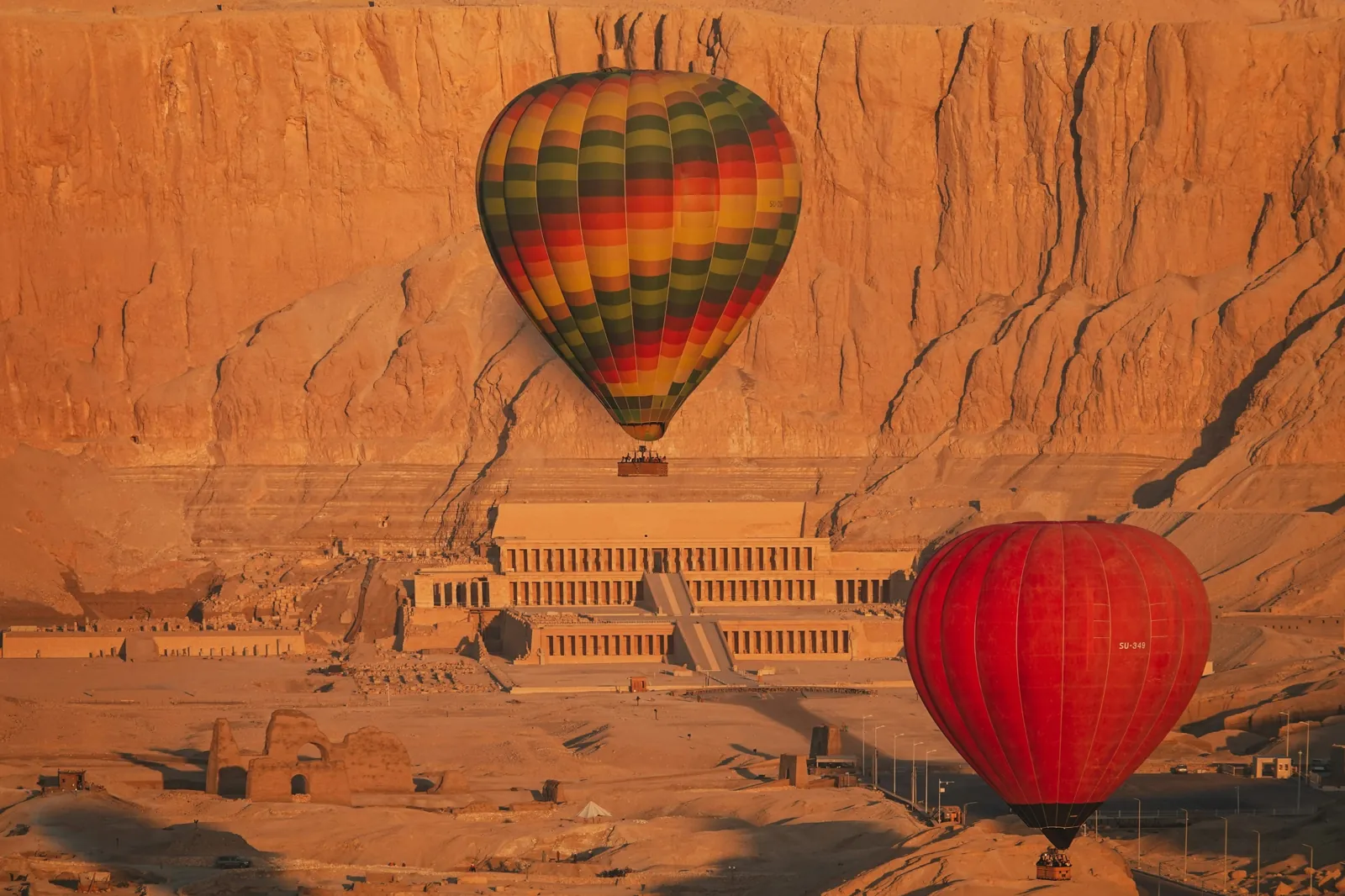
Luxor is the obvious choice and the busiest. The city has an international airport, a wide choice of hotels and Nile cruise ships, and temples on both banks of the river. Totality lasts almost as long here as anywhere in the country. Expect the highest prices and the biggest crowds, and plan for heat, because the Sun stands about 82° high at totality.
Most hotels
Airport
Busiest
Sohag, Abydos and Nag Hammadi
6m 26s to 6m 27s
The centre line runs through here, so these places get the longest totality we calculate for Egypt, with 6m 27s at Nag Hammadi and 6m 26s at Sohag and at the Temple of Seti I at Abydos. Far fewer foreign tourists come here than to Luxor. Sohag has an airport, though flights from Cairo are few, and hotel capacity is small.
Longest totality
Quieter
Few hotels
Qena and Dendera
6m 15s to 6m 18s
About an hour by road north of Luxor, Qena sits close to the Temple of Hathor at Dendera, famous for its zodiac ceiling, whose original now hangs in the Louvre. Totality is only about ten seconds shorter than in Luxor, and the town is an easy day trip for anyone staying there.
Near Luxor
Temple of Hathor
Asyut and Minya
6m 10s in Asyut, 4m 12s in Minya
Minya is the first stop inside the path for anyone coming south from Cairo, but it lies close to the northern edge, so its totality is shorter. Asyut, further south on the same rail line, is the first big city with more than six minutes. Both are working cities rather than tourist towns.
Nearest to Cairo
Rail line
The Red Sea coast
5m 33s in Marsa Alam, 6m 25s near Berenice
For a beach holiday with an eclipse, Marsa Alam has its own international airport and long stretches of resorts inside the path. Further south, near Berenice, totality reaches 6m 25s. El Quseir sits near the northern edge with 2m 31s, while Safaga and Hurghada are just outside the path and need a drive inland or south.
Beach resorts
Airport
Sea breeze
The Western Desert oases
5m 37s in Siwa, 6m 21s in Bahariya
The oases are the safest bet for a clear sky. Siwa Oasis and Bahariya lie deep in the desert, where cloud is almost unknown in August. Both are remote. Siwa is about 300 km by road from Marsa Matruh on the Mediterranean coast, and accommodation is limited to small lodges and hotels.
Clearest sky
Remote
Small lodges
How to choose
Longest totality
Nag Hammadi, Sohag or Abydos, on the centre line, with about 6m 27s.
Clearest sky
Siwa or Bahariya in the Western Desert.
Easiest trip
Luxor, with direct flights and the most hotels, or Marsa Alam for a beach base.
Fewer crowds
Sohag, Qena or Asyut, all quieter than Luxor.
Best Egypt solar eclipse tours 2027
The eclipse in Egypt is being called the event of the century, so tour prices change fast and most tours are already sold out. Do not count on a bargain. Seats on the best trips cost several thousand dollars per person, so an eclipse holiday in Egypt is mainly for travellers with a generous budget. We recommend tours from companies with the strongest reputations, but demand is high, so check prices and availability with the operator before you plan around them.
Tours of Distinction, via TourRadarEgypt Total Solar Eclipse 202713 daysCairo to CairoTotality in Luxor, with Cairo, Giza and a Nile cruisefrom US$5,299
On The Go ToursClassical Egypt and Luxor Total Eclipse 202711 daysCairo to Cairo, from 29 July 2027Totality in Luxor on day 5from US$4,231
Smithsonian JourneysSolar Eclipse Over Egypt Nile Cruise11 days28 July to 7 August 2027Totality on board the MS Tulip, moored at Luxorfrom US$14,695
Musement (TUI)Ancient Luxor and the total eclipse from HurghadaDay trip, 18 hoursHurghada hotel pick-up, 2 August 2027 onlyTotality in Luxor, with entrance fees, lunch and eclipse glassesfrom £142
Some of the most popular trips, including both Luxor departures from Astro Trails and the tour by Sirius Travel, are already sold out. Sirius Travel and Smithsonian Journeys keep waiting lists, and places do open up as people cancel, so it is worth asking to be added.
Every city in Egypt compared
Sort by totality, start time or Sun height. Cities outside the path show the share of the Sun covered instead.
2027 eclipse cities. Column headers sort the table.
Local clock time on 2 August 2027 when totality begins, or for a partial eclipse, the moment of greatest coverage.
Weather, heat and dust
Few places on the 2027 path have weather as reliable as Egypt’s. In the analysis of climatologist Jay Anderson, cloud is almost unknown over the Egyptian desert in summer, and only begins to appear, very rarely, around Luxor. Dust storms are occasional rather than frequent in the Nile Valley.
Heat is the real challenge. Luxor’s average high on 2 August is about 42°C (108°F), with a record of 46°C (115°F), according to the same analysis. Totality comes in the hottest part of the day, so plan shade, plenty of water and a cool place to rest afterwards, and keep children and older travellers out of the midday sun.
With the Sun about 80° high, you will be looking almost straight up. A reclining chair, a mat to lie on or a wide hat makes the partial phases far more comfortable for your neck.
Getting to the path
From Cairo to Luxor
Flights take about an hour. Overnight sleeper trains run by Watania leave Ramses station in the evening and reach Luxor the next morning, after about 9 to 10 hours on the 650 km line. A new luxury sleeper, the Guardian of the Nile, will also stop in Luxor on its way to Aswan, according to National Geographic.
Straight to the Nile Valley
Luxor, Sohag and Asyut all have airports. The one in Luxor takes international flights, including charters from Europe, while Sohag and Asyut mostly serve the Gulf, with only occasional flights from Cairo. Domestic flights around 2 August are likely to fill early.
From the Red Sea resorts
Hurghada’s airport has more flights from Europe than any other on the Red Sea. From Hurghada, the road via Safaga crosses the Eastern Desert to Qena on the Nile, inside the path. Marsa Alam is already in the path and has its own airport.
To the oases
Siwa has no regular flights. Most visitors drive from Marsa Matruh, about 300 km away, or join an organised tour from Cairo. Bahariya is reached by road from Cairo, across the desert to the south-west.
Hotels, crowds and viewing sites
Egypt’s Ministry of Tourism and Antiquities has set up a high-level committee, chaired by the minister, to plan the logistics, services and order at key observation sites. No official list of viewing sites has been published so far.
Luxor is the main base and the first to fill up. Two large hotels, the restored Mandarin Oriental Winter Palace and a new Four Seasons, are due to open in 2027. If you want to see the eclipse in Egypt, book today, and be ready for the fact that even today may already be too late. When Luxor is full, look at Qena, Sohag or the Red Sea coast and drive in on the morning of the eclipse.
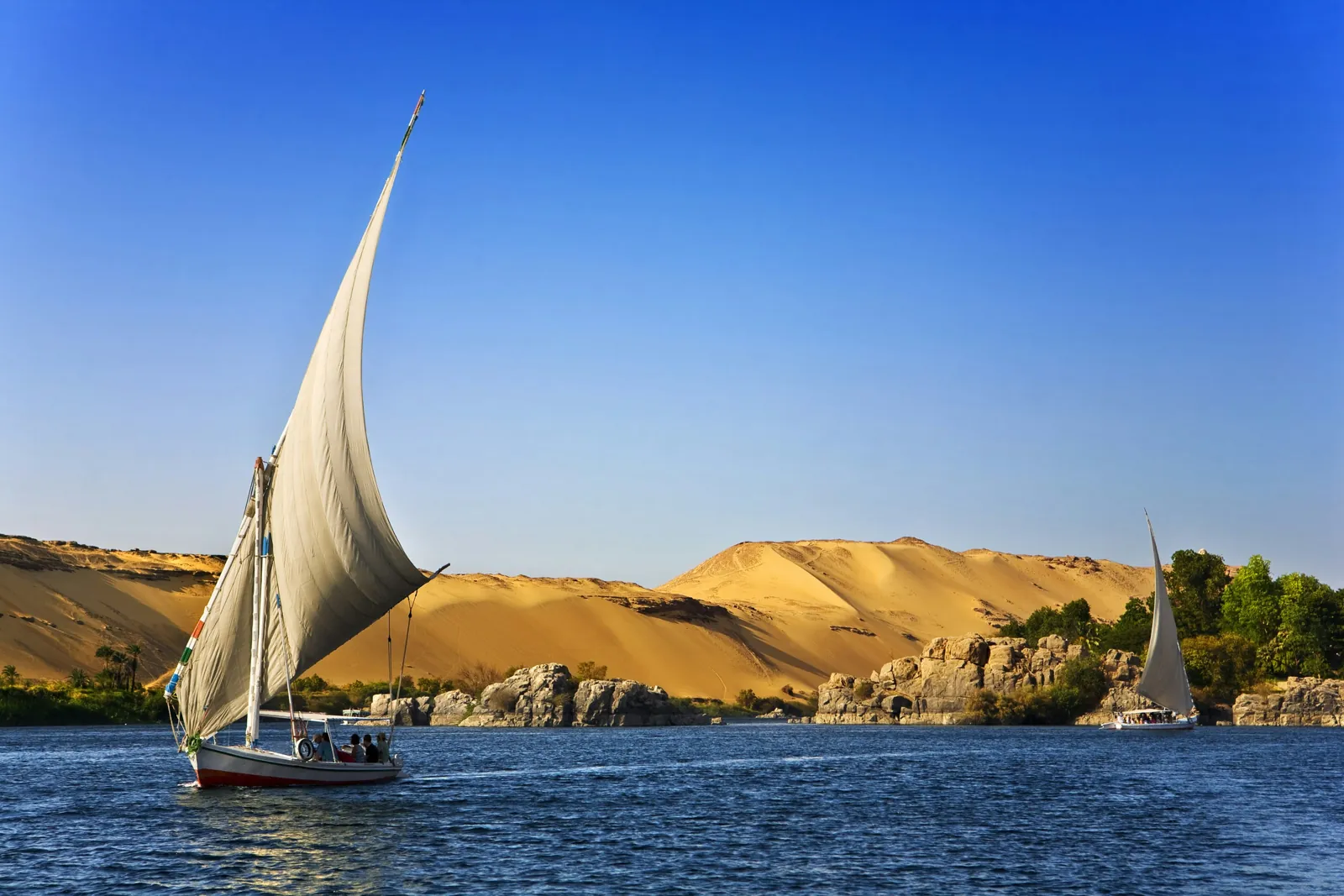
Nile cruises between Luxor and Aswan are popular for eclipse trips, but Aswan itself is just outside the path, with 99.8% of the Sun covered. A ship needs to be at Kom Ombo or further north on 2 August; at Edfu, totality lasts 5m 38s, and at Esna 5m 51s.
Outside the path in Egypt
A partial eclipse, even at 99%, leaves the sky bright and the corona hidden. Eclipse glasses stay on the whole time.
No. Cairo sees a partial eclipse with about 95% of the Sun covered. The nearest totality is around Minya, about 250 km to the south, with just over four minutes, or around Asyut, with just over six.
Is Aswan in the path of totality?
Aswan lies just beyond the southern edge, with 99.8% of the Sun covered. Kom Ombo, about 45 km north, gets 3m 37s of totality, and Edfu 5m 38s.
Where is the longest totality in Egypt?
On the centre line in the Nile Valley, around Nag Hammadi, Sohag and Abydos, where it lasts about 6m 27s by our calculation. Luxor gets 6m 25s.
What time is the eclipse in Egypt?
Totality begins between 12:42 at Siwa in the Western Desert and about 13:10 on the southern Red Sea coast, local time (UTC+3). In Luxor it starts at 13:01. The partial phases begin about 80 minutes before totality and end about 80 minutes after it.
Can I see the total eclipse from Hurghada?
No. Hurghada sees about 98.5% of the Sun covered. The road inland via Safaga reaches the path near Qena on the Nile, and Marsa Alam to the south is inside the path.
How hot will it be?
Very hot. Luxor averages about 42°C (108°F) on 2 August, and totality comes in the early afternoon. Plan shade, water and a cool place to rest afterwards.