A shadow, nothing more
On a sunny day you cast a shadow on the ground. The Moon does the same in space all the time, but its shadow usually points into empty space and misses us. A few times a year the Moon passes directly between the Sun and the Earth, and its shadow lands on our planet. Anyone standing inside it sees the Moon slide across the Sun.
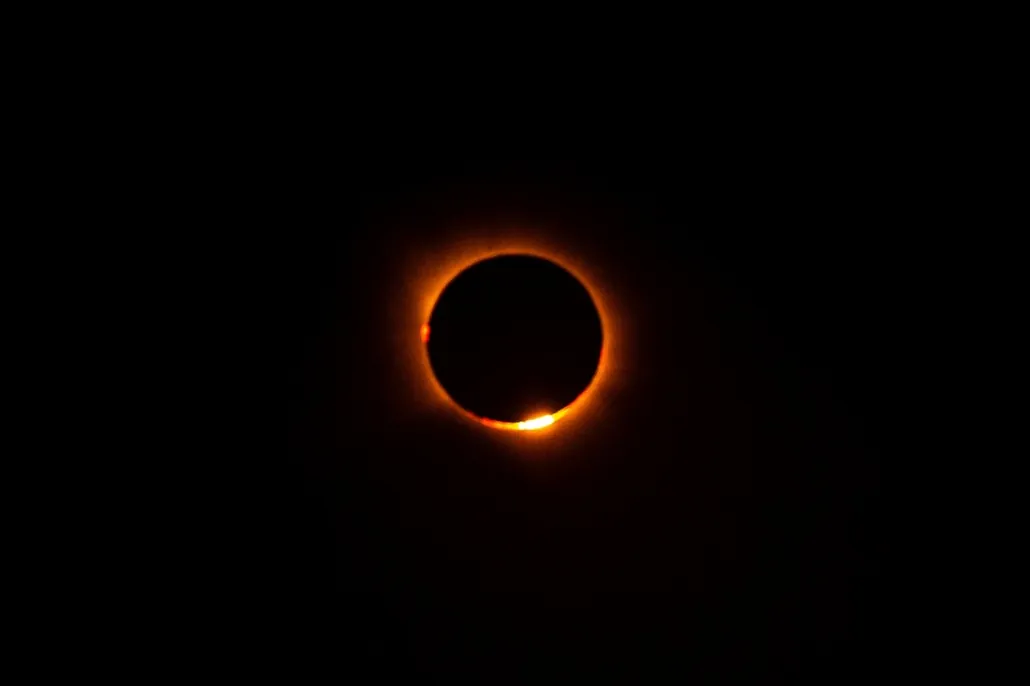
The line-up can only happen at new moon, when the Moon sits on the sunny side of the Earth and its night side faces us. We cannot see a new moon in the sky, because its lit half points away. During an eclipse you finally see it, as a black disc cutting into the Sun.
Why the small Moon can hide the huge Sun
At about 1.4 million km across, the Sun dwarfs the 3,474 km Moon. It is about 400 times wider, but it is also roughly 400 times farther away. Those two numbers cancel out, so from the Earth both discs look almost exactly the same size, about half a degree across.
Half a degree is tiny. A coin 2.3 cm across, held about 2.5 m from your eye, covers the same patch of sky. Your little fingernail at arm’s length hides the whole Sun with room to spare,
Why it doesn’t happen every new moon
New moon comes roughly every 29.5 days, yet most months bring no eclipse. The Moon’s orbit is tilted by about 5 degrees compared with the Earth’s path around the Sun. At most new moons the Moon passes a little above or below the Sun, and its shadow flies past the Earth into space.
Picture two hula hoops, one inside the other, tilted slightly against each other. They touch at only two points, called nodes. An eclipse needs a new moon close to one of those two points, so that the Sun, the Moon and the Earth line up in three dimensions and not just from above.
Two eclipse seasons a year
As the Earth travels around the Sun, the Sun lines up with the nodes twice a year, roughly six months apart. Each of those windows, called an eclipse season, lasts about 35 days. A new moon always falls somewhere inside that window, so every season brings at least one solar eclipse, and sometimes two a month apart.
Each row shows two seasons, and they creep earlier every year. The nodes slowly turn backwards around the sky, so each season starts about 19 days sooner every year. Each eclipse falls on whichever new moon lands inside the window, so their dates shift less evenly: 6 February and 2 August in 2027, then 26 January and 22 July in 2028. In 2029 three seasons fit into one calendar year, and the middle one holds two new moons close enough to a node, giving four partial eclipses in a single year.
The same seasons also bring lunar eclipses. A full moon falls about two weeks before or after the new moon, and if it is close to a node, the Moon passes through the Earth’s shadow. Solar and lunar eclipses therefore tend to come in pairs a fortnight apart.
Umbra and penumbra: one Moon, two shadows
Hold your hand under a desk lamp and look at its shadow: the middle is dark, and the edges are soft and grey. The Moon’s shadow works the same way, because the Sun is a wide disc and not a single point of light.
The umbra is the dark core, where the whole Sun is hidden. By the time it reaches the Earth it is small: on 2 August 2027 it is up to about 258 km wide. The track it draws across the planet is the path of totality, and only people inside it see a total eclipse.
Around it lies the penumbra, a soft outer shadow where only part of the Sun is covered. It spreads over thousands of kilometres, so far more people see a partial eclipse than a total one. In 2027, Madrid sees about 86% of the Sun covered, Lisbon 92% and Cairo 95%, yet none of them gets totality.
Total or ring of fire: when the shadow is too short
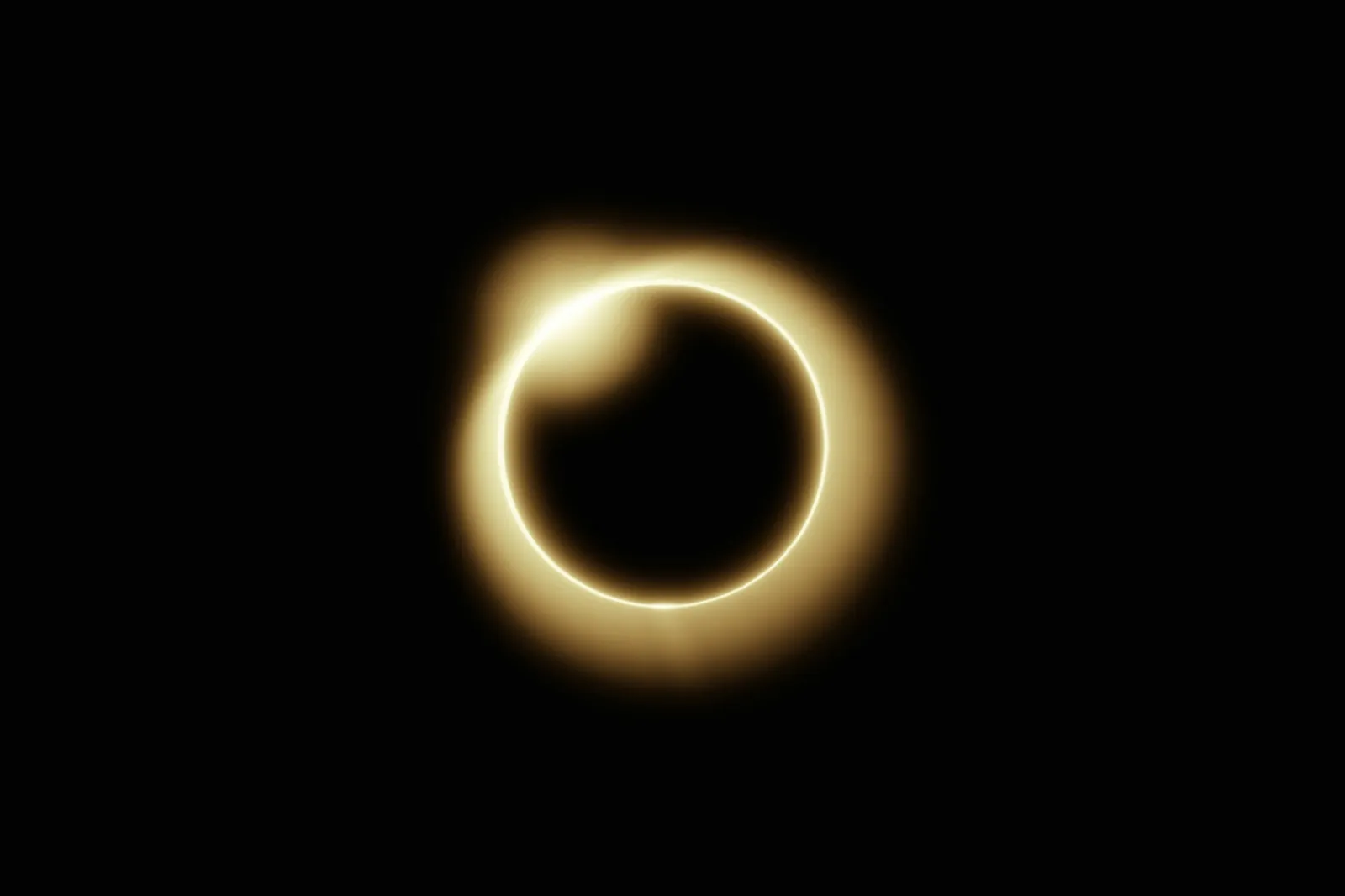
The umbra is a cone that narrows to a point. On average it is about 374,000 km long, almost exactly the distance to the Moon. Whether it reaches the ground depends on how far away the Moon is that day, because its orbit is an oval and not a circle.
When the Moon is near its closest point, the tip of the cone stabs into the Earth and the people under it see a total eclipse. Near its farthest point, the tip ends tens of thousands of kilometres above the ground. The Moon then looks slightly too small for the Sun, and a thin ring of sunlight stays visible around it: an annular eclipse, often called a ring of fire. When the tip only just touches the curve of the Earth, the same eclipse can be total in the middle of its path and annular at both ends. Astronomers call it a hybrid. Each type is explained in our guide to total, annular, partial and hybrid eclipses.
How fast the shadow moves
Moving at about 1 km per second along its orbit, the Moon drags its shadow across the ground from west to east. Our planet spins in the same direction, so the ground partly “runs after” the shadow and slows it down, most of all near the equator at midday.
- Airliner at cruising speed900 km/h
- Concorde at Mach 22,180 km/h
- Moon’s shadow over Egypt, 20272,400 km/h
- Moon’s shadow over southern Spain, 20274,700 km/h
Its speed also depends on the angle at which it meets the surface. Along the centre line of the 2027 eclipse, the shadow crosses southern Spain at roughly 4,700 km/h in the morning, when the Sun is low and the shadow hits the ground at a slant. Over Egypt, with the Sun almost overhead, it slows to about 2,400 km/h. According to NASA, the shadow can reach about 8,000 km/h near the poles, where it strikes the Earth at a glancing angle.
A shadow a couple of hundred kilometres wide, moving at more than 2,000 km/h, passes any one spot in a few minutes. The astronomer Jean Meeus calculated that totality can never last longer than about 7 minutes 32 seconds. Only a supersonic jet can keep up: in 1973 a prototype Concorde chased the shadow across Africa and gave the scientists on board 74 minutes of totality.
How long one place waits for totality
Somewhere on Earth there is a total solar eclipse roughly every 18 months, but most paths cross oceans, deserts or polar ice. Any single spot has to wait far longer: on average, about 375 years between two total eclipses. Some places get lucky, and southern Spain sees totality in 2027 just a year after northern Spain saw it in 2026. Others wait many centuries.
Eclipses come in families: the saros
Ancient Babylonian astronomers noticed that eclipses repeat after about 18 years, 11 days and 8 hours, a cycle now called the saros. After one saros the Sun, the Moon and the nodes return to almost the same arrangement, so a very similar eclipse happens again, with a similar length and at the same time of year.
The extra 8 hours matter. In that time the Earth turns about a third of the way round, so each new eclipse in the family lands roughly 120 degrees of longitude farther west. The long total eclipse of 22 July 2009 crossed India and China. Its next return is 2 August 2027 over Spain, North Africa and Arabia, 6585.31 days later by our calculation, exactly one saros. One saros later, on 12 August 2045, the next eclipse of the family crosses the United States.
A saros family lasts about 1,200 to 1,500 years. It begins with small partial eclipses near one pole, the shadow moves a little closer to the equator with each return, and after eight or nine centuries of total or annular eclipses it drifts off the opposite pole and the family dies out.
Eclipses will not last forever
The Moon is slowly moving away from the Earth, by about 3.8 cm a year. Scientists measure the change by bouncing lasers off reflectors left on the Moon by the Apollo 11, 14 and 15 astronauts. As the Moon drifts away it looks a little smaller, and NASA estimates that in roughly 650 million years it will no longer be able to cover the Sun completely. After that, the Earth will only have annular and partial eclipses, so the total eclipses we can chase today belong to a limited chapter in the planet’s history.
Good questions
- Why don’t we have a solar eclipse every month?
- The Moon’s orbit is tilted by about 5 degrees to the Earth’s orbit around the Sun, so at most new moons the Moon passes a little above or below the Sun. An eclipse only happens when new moon falls near one of the two points where the orbits cross, and the Sun passes those points during two eclipse seasons a year.
- How fast does the Moon’s shadow move?
- It depends where you are on the path. In 2027 the centre of the shadow slows to about 2,400 km/h near greatest eclipse in Egypt, but races across southern Spain at roughly 4,700 km/h because the Sun is low there.
- How many solar eclipses are there in a year?
- Between 2 and 5. In the 110 years from 1926 to 2035, every calendar year has at least 2 solar eclipses, and 1935 has 5.
- Can a solar eclipse happen at night?
- No. A solar eclipse is only visible where the Sun is above the horizon, so the night side of the Earth sees nothing. Lunar eclipses are the opposite: they happen at full moon and are seen from the night side.
Sources
- NASA Science, Solar eclipses
- NASA Sun-Earth Day, How fast does the Moon’s shadow move?
- NASA JPL, The Apollo experiment that keeps on giving
- NASA, What’s the very last solar eclipse?