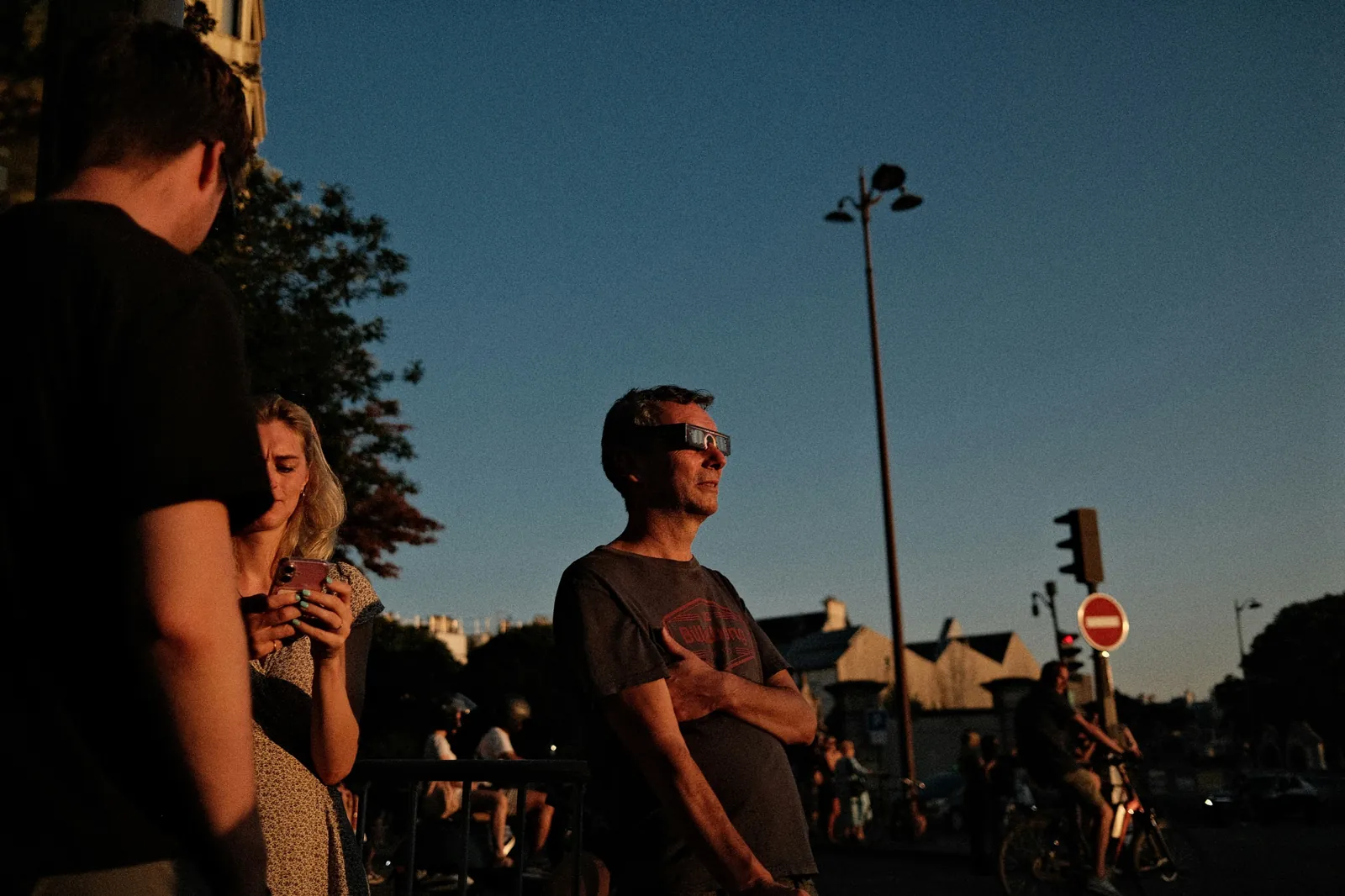
Glasses on, glasses off: the whole eclipse at a glance
NASA’s advice is to remove your solar filter “ONLY when the Moon completely covers the Sun’s bright face”, and to put it back “as soon as the Sun begins to reappear”. You will know the moment has come when you can no longer see any part of the Sun through your glasses.
Can I look now?
Move the slider through the eclipse to see what the Sun looks like at each stage and whether it is safe to look without protection.
Before the eclipse0%
Not safe to lookThe Sun is uncovered. Never look at it directly.
Why a 99% eclipse is still dangerous
Once most of the Sun is covered, it is tempting to think the danger has passed, but it has not. In a technical report for the American Astronomical Society, the optometrist B. Ralph Chou explains that even when 99% of the Sun’s surface is hidden, the remaining crescent “is still intense enough to cause a retinal photochemical injury”.
The 1999 figures come from a national study published in the journal Eye in 2001, which counted 70 reported cases of vision loss after the total eclipse of 11 August 1999, and from Public Health England, which noted that 40% of those injured had looked for less than a minute. In a technical report for the AAS, Chou adds that most people injured by eclipses are children and young adults.
Is your pair of eclipse glasses safe?
Fake eclipse glasses appear before every big eclipse. The American Astronomical Society warns that a claim of ISO compliance on the product or its package is not enough on its own, because the ISO logo is easy to copy and some sellers even print the names of real manufacturers on their own products. Tick off each point below.
For certified picks, a comparison table and the models withdrawn in Spain in 2026, see our guide to the best eclipse glasses for 2027.
Tick every point. If even one point fails, do not use the glasses.
The AAS keeps a public list of manufacturers whose viewers meet the standard, and says that “as long as you can trace your filters to a manufacturer listed above, you have nothing to worry about.” For the eclipses of 2026 and 2027 in Spain it also points to the Spanish volunteer observers’ group OVAE, which vets suppliers on its Eclipse Seguro website. Spain’s Instituto Geográfico Nacional adds a simple label check: look for “EN ISO 12312-2:2015”, and if the glasses only say ISO 12312-1, they are ordinary sunglasses and not suitable for looking at the Sun.
Safe and unsafe ways to watch
ISO 12312-2 eclipse glasses or a handheld solar viewer from a known supplier
For every partial phase. Check them for damage first.
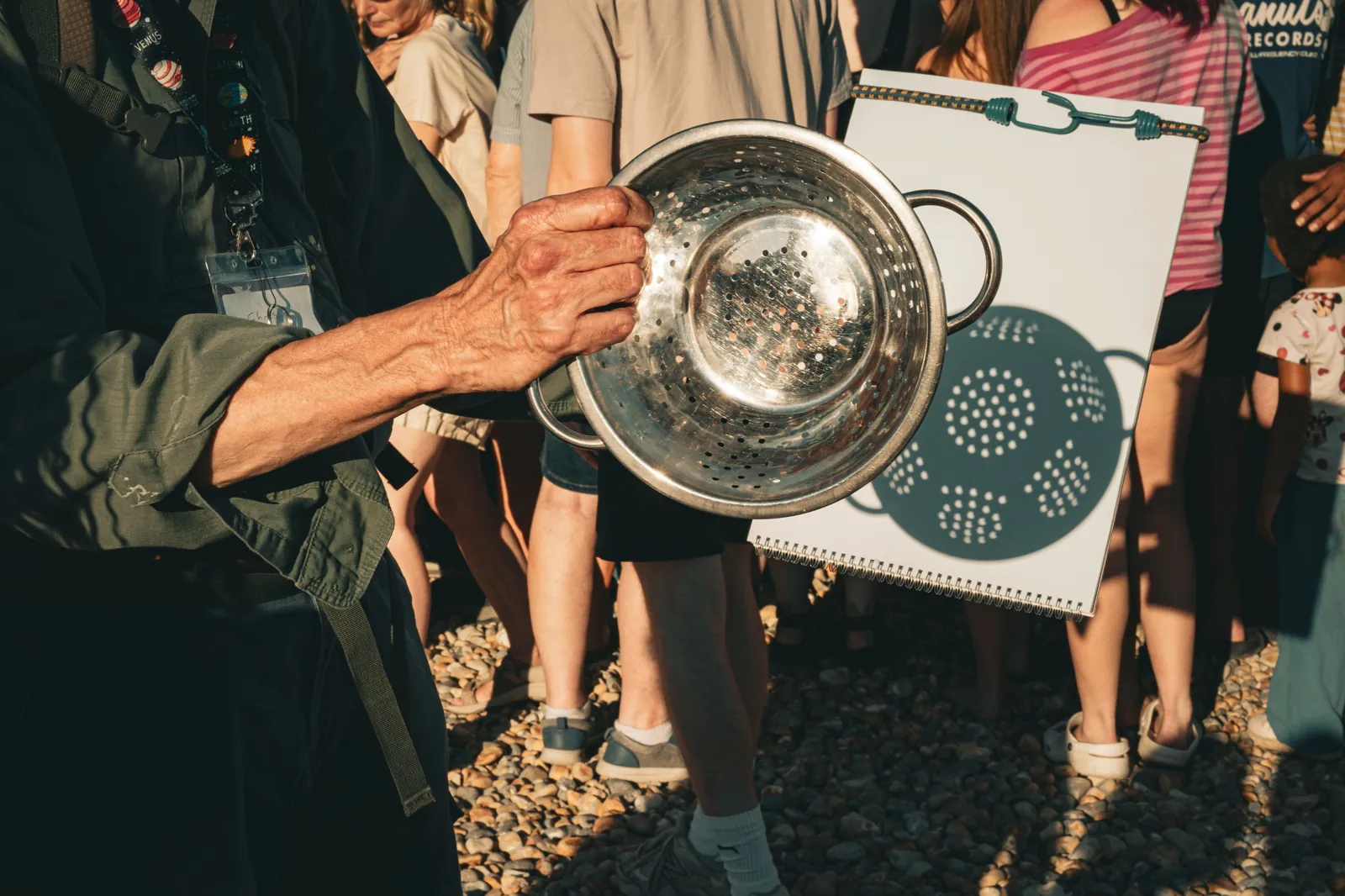
Pinhole projector, colander or the crescents under a tree
You look at the projected image, never at the Sun through the hole.
Telescope, binoculars or camera with a proper solar filter on the front
The filter must cover the front of the lens, not the eyepiece.
Welding glass, shade 12 or darker
Safe at shade 12 or above, but most welding helmets are lighter than that.
Watching a live broadcast
The safest option of all, recommended by UK eye doctors.
Your own eyes during totality
Only while the Sun is completely covered.
Sunglasses, even very dark or several pairs
They let through thousands of times too much light.
Glasses labelled only ISO 12312-1
ISO 12312-1 covers ordinary sunglasses, not looking at the Sun.
Smoked glass, exposed film, X-ray film, CDs
Homemade filters block too little light, especially infrared.
Binoculars, telescope or camera without a front filter
They concentrate sunlight. Eclipse glasses held at the eyepiece do not help.
Looking at a 99% partial eclipse without protection
The thin crescent is still bright enough to burn the retina.
NASA puts it bluntly: “Eclipse glasses are NOT regular sunglasses; regular sunglasses, no matter how dark, are not safe for viewing the Sun.” The European Space Agency adds that you should never look at the Sun “with any unfiltered optical device, such as binoculars or a telescope”. A solar filter on binoculars, a telescope or a camera must sit on the front of the instrument, where the sunlight enters, and NASA warns specifically against holding eclipse glasses or handheld viewers up to cameras, binoculars or telescopes.
Using eclipse glasses the right way
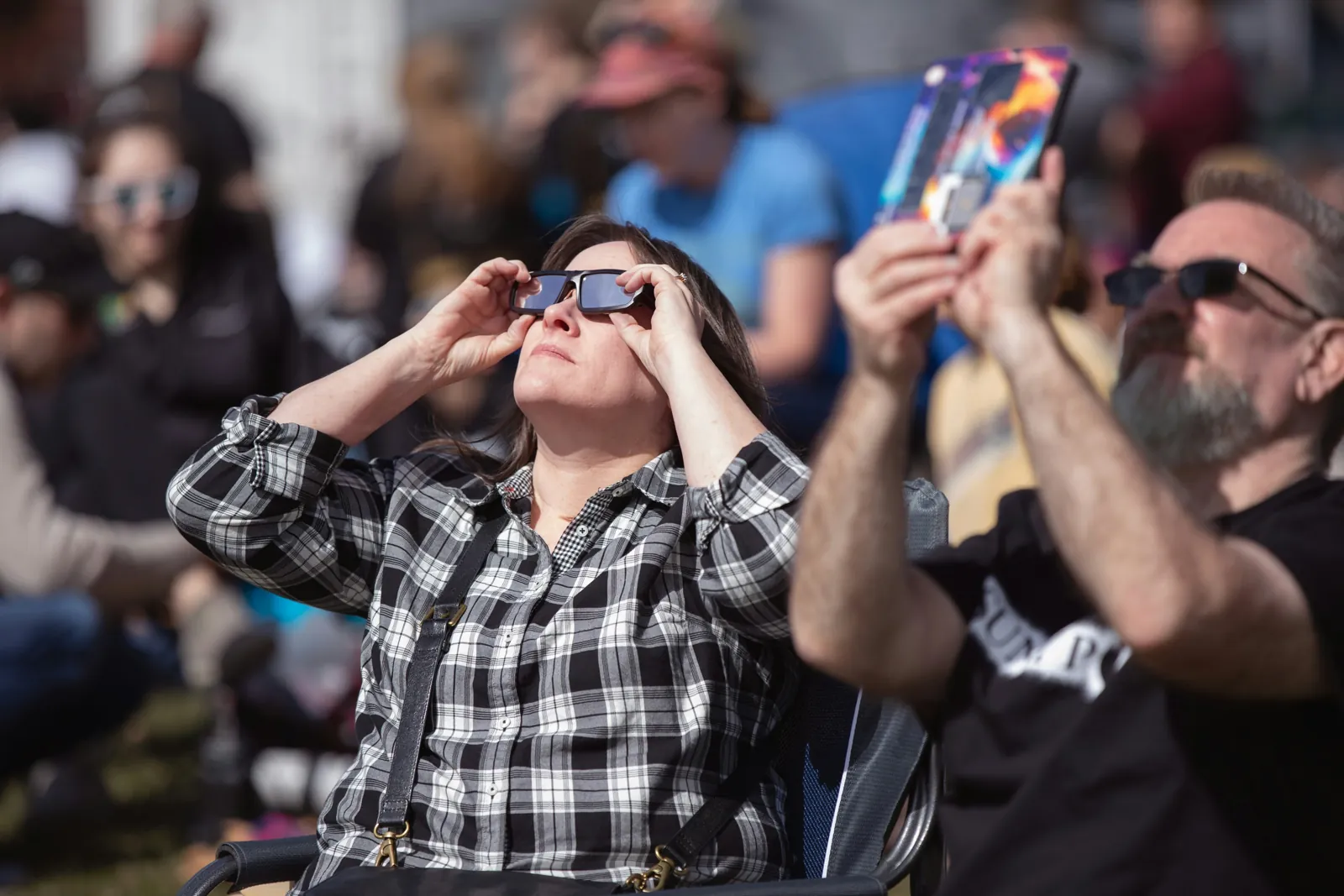
Good glasses only protect you if you use them properly. The AAS and NASA give the same simple routine:
- Stand still and put the glasses on before you look up at the Sun.
- Look away from the Sun before you take them off, never while you are still facing it. The only exception is totality, when the Sun is completely covered.
- Take them off for totality only once you can see no part of the Sun through them. If you are near the edge of the path and not sure you are inside it, keep them on.
- Put them back on at the first flash of sunlight. Your pupils have widened in the dark, so the returning light reaches deeper into your eyes.
- If you wear prescription glasses, keep them on and put the eclipse glasses over them.
- Treat a low Sun near the horizon with the same care: it can feel gentle enough to stare at, but it can still damage your eyes.
- Do not walk around or drive with eclipse glasses on: through them you can see the Sun and almost nothing else.
If your eyes feel sore or your vision seems different after an eclipse, our guide to what to do when your eyes hurt after an eclipse explains the warning signs and when to see a doctor.
Children
NASA and the AAS both say to always supervise children using solar viewers, and the College of Optometrists advises keeping glasses on children throughout the partial phases. Check that the glasses fit closely enough that a child cannot peek around them. For young children a pinhole projector is often better: the eclipse appears as a small crescent on paper or on the ground, and nobody needs to look towards the Sun at all.
If your vision changes after the eclipse
Eclipse damage, called solar retinopathy, does not usually hurt. The College of Optometrists says to look out for blurring, distortion or changes to your colour vision, and the American Optometric Association advises that all symptoms should be treated as urgent until an eye doctor has seen you. A blind or dark spot in the centre of your vision is another warning sign. If you notice any of these in the hours or days after the eclipse, see an optometrist, an ophthalmologist or an emergency eye service and tell them you watched the eclipse.
Good questions
- Can I look at a solar eclipse with sunglasses?
- No. NASA says regular sunglasses, no matter how dark, are not safe for viewing the Sun. Eclipse glasses meeting ISO 12312-2 are thousands of times darker.
- Is it safe to look at the eclipse during totality?
- Yes, but only during totality, while the Sun is completely covered. Put your glasses back on as soon as the first bright point of sunlight returns.
- Do eclipse glasses expire?
- Not after a fixed date. The American Astronomical Society says modern solar viewers last up to 10 years if they are stored well and undamaged. Throw away any pair that is scratched, punctured, torn or coming loose from its frame.
- Can I photograph the eclipse with my phone?
- Advice differs. The UK College of Optometrists advises against watching or photographing it on a phone, because glancing up to line up the shot already exposes your eyes. If you do, keep your eclipse glasses on while you aim, and only point the phone at the uncovered Sun with a solar filter over its lens.
Sources
- American Astronomical Society, How can you tell if your eclipse glasses or handheld solar viewers are safe?
- American Astronomical Society, About the ISO 12312-2 standard for solar viewers
- American Astronomical Society, Suppliers of safe solar viewers and filters
- B. Ralph Chou, Solar eclipse eye safety, AAS technical report (2023)
- NASA Science, Eclipse viewing safety
- Royal College of Ophthalmologists, College advises eclipse watchers against looking directly at the sun (August 2026)
- The College of Optometrists, Eye safety advice ahead of the summer solar eclipse (August 2026)
- European Space Agency, Safety tips for observing the Sun
- American Academy of Ophthalmology, Safe solar eclipse viewing
- Michaelides M. et al., Eclipse retinopathy, Eye 15, 148–151 (2001)
- Public Health England, Don’t let your eyes take the strain in the eclipse (2015, archived)
- American Optometric Association, Eye safety information ahead of the total solar eclipse (2024)
- Instituto Geográfico Nacional (Spain), Recomendaciones prácticas y productos