The map: how much of the Sun is covered
The closer you are to the path of totality, the bigger the bite the Moon takes out of the Sun. On the map, each band shows the coverage at the peak of the eclipse.
What 40%, 75%, 95% and 99% look like
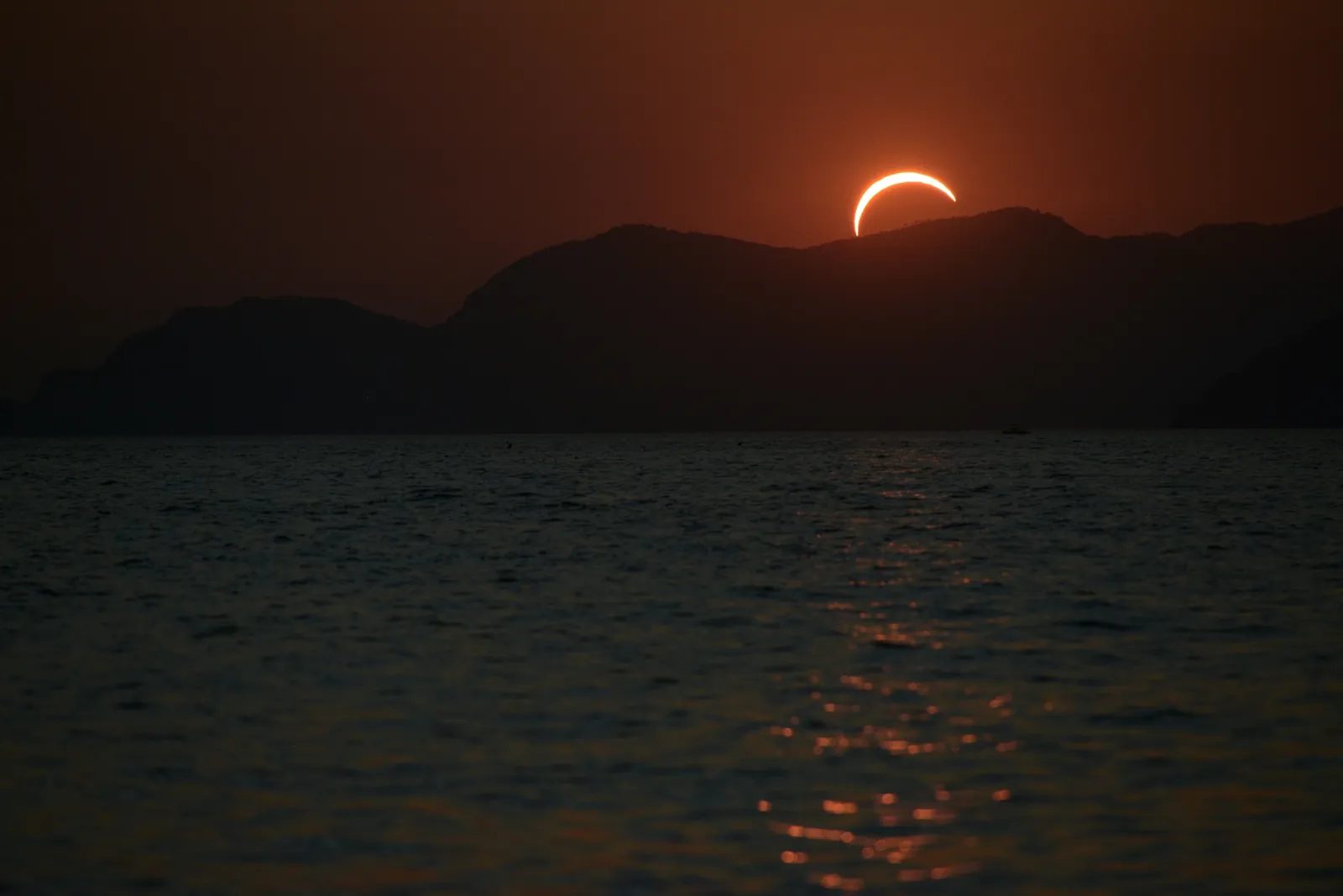
Below about half, most people would not notice anything without eclipse glasses: the remaining Sun is still blinding and daylight looks normal. Around three quarters, the light becomes slightly flat and cooler, and the shadows of leaves turn into small crescents on the ground. Above 90%, the sky darkens noticeably, the air cools and colours look washed out, as if someone had turned down the light.
Even at 99%, the remaining sliver of Sun is still thousands of times brighter than a full moon, so the corona never appears and you need eclipse glasses from start to finish. The difference between 99% and 100% is the reason people travel to the path.
Europe
Almost all of Europe sees part of the eclipse, in the morning or around midday. Coverage falls from more than 95% just outside the path in southern Spain to about a quarter in Scotland, Poland and Ukraine and a small bite of about 6% in Reykjavik. The far north of Norway sees nothing at all.
Spain
The path cuts across the far south, so the cities just outside it see more than 95% of the Sun covered: Seville, Granada, Huelva and Almería are all a short drive from totality, and Almería misses it by only a few kilometres. In the north and on the Canary Islands the Moon covers roughly three quarters of the Sun.
| City | Sun covered | Peak | Begins and ends | Sun height |
|---|---|---|---|---|
| Almería | 99.9% | 10:51 | 09:43 to 12:05 | 41° |
| Granada | 99.1% | 10:50 | 09:42 to 12:03 | 40° |
| Huelva | 99% | 10:46 | 09:40 to 11:58 | 37° |
| Seville | 98% | 10:47 | 09:41 to 11:59 | 38° |
| Córdoba | 97% | 10:48 | 09:42 to 12:01 | 39° |
| Murcia | 96% | 10:53 | 09:45 to 12:07 | 43° |
| Alicante | 95% | 10:54 | 09:46 to 12:08 | 43° |
| Valencia | 90% | 10:54 | 09:46 to 12:08 | 43° |
| Palma | 89% | 10:58 | 09:49 to 12:13 | 46° |
| Madrid | 86% | 10:51 | 09:45 to 12:02 | 40° |
| Barcelona | 82% | 10:58 | 09:50 to 12:11 | 45° |
| Zaragoza | 81% | 10:54 | 09:48 to 12:06 | 42° |
| Santa Cruz de Tenerife | 79% | 09:33 | 08:32 to 10:41 | 26° |
| Las Palmas | 77% | 09:34 | 08:33 to 10:42 | 27° |
| Bilbao | 74% | 10:53 | 09:48 to 12:02 | 40° |
Local clock time, UTC+2 (Santa Cruz de Tenerife and Las Palmas: UTC+1).
Portugal
Portugal stays outside the path, but the Algarve comes very close: Faro sees 99.2%, and totality at Cádiz is a drive of about three hours. Lisbon gets 92%, Madeira 97%.
| City | Sun covered | Peak | Begins and ends | Sun height |
|---|---|---|---|---|
| Faro | 99.1% | 09:45 | 08:40 to 10:56 | 36° |
| Funchal | 97% | 09:34 | 08:33 to 10:43 | 26° |
| Lisbon | 92% | 09:44 | 08:40 to 10:54 | 35° |
| Ponta Delgada | 87% | 08:32 | 07:36 to 09:35 | 19° |
| Porto | 82% | 09:46 | 08:43 to 10:55 | 35° |
Local clock time, UTC+1 (Ponta Delgada: UTC+0).
France
The south of France sees about three quarters of the Sun covered, Paris about half, all within a few minutes of 11:00.
| City | Sun covered | Peak | Begins and ends | Sun height |
|---|---|---|---|---|
| Marseille | 73% | 11:02 | 09:55 to 12:14 | 47° |
| Toulouse | 72% | 10:58 | 09:52 to 12:08 | 44° |
| Nice | 70% | 11:05 | 09:57 to 12:16 | 49° |
| Bordeaux | 68% | 10:56 | 09:52 to 12:04 | 42° |
| Lyon | 63% | 11:02 | 09:58 to 12:11 | 46° |
| Paris | 51% | 11:01 | 10:00 to 12:04 | 43° |
Local clock time, UTC+2.
Italy
Sicily and Sardinia get close to 90%, Rome and Naples about three quarters, and the north around 60%.
| City | Sun covered | Peak | Begins and ends | Sun height |
|---|---|---|---|---|
| Palermo | 89% | 11:14 | 10:00 to 12:32 | 57° |
| Cagliari | 88% | 11:07 | 09:56 to 12:24 | 53° |
| Naples | 77% | 11:15 | 10:03 to 12:30 | 56° |
| Rome | 74% | 11:12 | 10:02 to 12:26 | 54° |
| Bari | 74% | 11:19 | 10:07 to 12:34 | 58° |
| Milan | 62% | 11:08 | 10:02 to 12:17 | 50° |
| Venice | 60% | 11:12 | 10:05 to 12:21 | 52° |
Local clock time, UTC+2.
Malta
Malta comes close to totality, with 97% of the Sun covered just after 11:15 and the Sun high in the sky.
| City | Sun covered | Peak | Begins and ends | Sun height |
|---|---|---|---|---|
| Valletta | 97% | 11:17 | 10:01 to 12:37 | 60° |
Local clock time, UTC+2.
Greece
Crete sees the most, 86%, while Athens gets 78% at about half past noon.
| City | Sun covered | Peak | Begins and ends | Sun height |
|---|---|---|---|---|
| Heraklion | 86% | 12:37 | 11:18 to 13:56 | 69° |
| Athens | 78% | 12:32 | 11:16 to 13:49 | 66° |
| Rhodes | 77% | 12:42 | 11:24 to 13:59 | 70° |
| Thessaloniki | 69% | 12:29 | 11:16 to 13:43 | 63° |
Local clock time, UTC+3.
United Kingdom
London sees 42% at about 10:00. Further north the bite shrinks, to just over a quarter of the Sun in Edinburgh.
| City | Sun covered | Peak | Begins and ends | Sun height |
|---|---|---|---|---|
| London | 42% | 10:00 | 09:03 to 10:59 | 40° |
| Birmingham | 38% | 09:59 | 09:04 to 10:56 | 39° |
| Manchester | 35% | 09:59 | 09:06 to 10:55 | 38° |
| Edinburgh | 27% | 10:00 | 09:11 to 10:51 | 37° |
Local clock time, UTC+1.
Ireland
Dublin sees just over a third of the Sun covered, shortly before 10:00.
| City | Sun covered | Peak | Begins and ends | Sun height |
|---|---|---|---|---|
| Dublin | 36% | 09:56 | 09:03 to 10:51 | 36° |
Local clock time, UTC+1.
Germany
Munich gets half the Sun covered, Berlin and Hamburg about a third.
| City | Sun covered | Peak | Begins and ends | Sun height |
|---|---|---|---|---|
| Munich | 50% | 11:11 | 10:08 to 12:16 | 50° |
| Frankfurt | 44% | 11:08 | 10:08 to 12:10 | 47° |
| Berlin | 34% | 11:13 | 10:17 to 12:11 | 48° |
| Hamburg | 32% | 11:10 | 10:15 to 12:06 | 46° |
Local clock time, UTC+2.
Netherlands and Belgium
| City | Sun covered | Peak | Begins and ends | Sun height |
|---|---|---|---|---|
| Brussels | 43% | 11:03 | 10:05 to 12:04 | 44° |
| Amsterdam | 38% | 11:05 | 10:08 to 12:03 | 43° |
Local clock time, UTC+2.
Switzerland and Austria
| City | Sun covered | Peak | Begins and ends | Sun height |
|---|---|---|---|---|
| Geneva | 60% | 11:04 | 09:59 to 12:12 | 47° |
| Zurich | 55% | 11:07 | 10:03 to 12:14 | 48° |
| Vienna | 47% | 11:17 | 10:14 to 12:22 | 53° |
Local clock time, UTC+2.
Croatia
The Dalmatian coast sees about two thirds of the Sun covered, a little more than Zagreb.
| City | Sun covered | Peak | Begins and ends | Sun height |
|---|---|---|---|---|
| Dubrovnik | 67% | 11:20 | 10:10 to 12:33 | 58° |
| Split | 65% | 11:18 | 10:08 to 12:30 | 56° |
| Zagreb | 56% | 11:16 | 10:10 to 12:25 | 54° |
Local clock time, UTC+2.
Central and Eastern Europe
| City | Sun covered | Peak | Begins and ends | Sun height |
|---|---|---|---|---|
| Sofia | 61% | 12:28 | 11:18 to 13:40 | 62° |
| Bucharest | 51% | 12:32 | 11:24 to 13:40 | 61° |
| Budapest | 47% | 11:20 | 10:16 to 12:26 | 55° |
| Odesa | 39% | 12:37 | 11:34 to 13:40 | 61° |
| Warsaw | 30% | 11:22 | 10:26 to 12:19 | 52° |
| Kyiv | 27% | 12:34 | 11:38 to 13:30 | 57° |
Local clock time, UTC+3 (Budapest and Warsaw: UTC+2).
Turkey
In Turkey the eclipse peaks around 12:40 local time. The Aegean and Mediterranean coasts see more than 70%, Istanbul and Ankara a little less than 60%.
| City | Sun covered | Peak | Begins and ends | Sun height |
|---|---|---|---|---|
| Izmir | 71% | 12:38 | 11:22 to 13:53 | 68° |
| Antalya | 71% | 12:46 | 11:29 to 14:01 | 70° |
| Istanbul | 59% | 12:39 | 11:27 to 13:50 | 66° |
| Ankara | 57% | 12:46 | 11:34 to 13:57 | 68° |
Local clock time, UTC+3.
Cyprus
| City | Sun covered | Peak | Begins and ends | Sun height |
|---|---|---|---|---|
| Limassol | 75% | 12:52 | 11:34 to 14:09 | 73° |
| Nicosia | 72% | 12:52 | 11:35 to 14:08 | 73° |
Local clock time, UTC+3.
North Africa
The path runs the length of North Africa, so the large cities outside it still see a very deep eclipse. Most of them get more than 90% of the Sun covered.
Morocco
The path crosses the north of the country, from Tangier and Tetouan to Oujda. Rabat (99%) and Fes (98%) lie just south of it, and Casablanca gets 97%. Since September 2026 Morocco has been on GMT all year, so its clock times are two hours behind Spain’s.
| City | Sun covered | Peak | Begins and ends | Sun height |
|---|---|---|---|---|
| Rabat | 99% | 08:45 | 07:39 to 09:58 | 37° |
| Fes | 98% | 08:47 | 07:40 to 10:01 | 39° |
| Casablanca | 97% | 08:44 | 07:38 to 09:57 | 36° |
| Marrakech | 89% | 08:43 | 07:37 to 09:56 | 36° |
| Agadir | 85% | 08:40 | 07:36 to 09:53 | 34° |
Local clock time, UTC+0.
Algeria
Oran lies inside the path, while Algiers and Constantine sit just outside it, with 99.8% and 99.9% of the Sun covered.
| City | Sun covered | Peak | Begins and ends | Sun height |
|---|---|---|---|---|
| Constantine | 99.9% | 10:04 | 08:51 to 11:22 | 51° |
| Algiers | 99.8% | 09:58 | 08:48 to 11:15 | 47° |
| Annaba | 98% | 10:06 | 08:53 to 11:24 | 52° |
Local clock time, UTC+1.
Tunisia
Sousse, with 99.8%, sits right at the edge of the path, and Tunis gets 97%. Sfax, Kasserine and Djerba to the south are inside it.
| City | Sun covered | Peak | Begins and ends | Sun height |
|---|---|---|---|---|
| Sousse | 99.8% | 10:10 | 08:56 to 11:30 | 56° |
| Tunis | 97% | 10:09 | 08:56 to 11:28 | 55° |
Local clock time, UTC+1.
Libya
The path crosses the populated north of Libya, and both Tripoli and Benghazi see a total eclipse, so they are not listed here. Further south, the desert sees a partial eclipse of about 80%. Our Libya page lists the times and explains the travel warnings.
Egypt
Cairo gets 95% and Alexandria 93%. Aswan and Hurghada sit just outside the band that crosses the Nile Valley around Luxor, with 99.8% and 99%.
| City | Sun covered | Peak | Begins and ends | Sun height |
|---|---|---|---|---|
| Aswan | 99.8% | 13:08 | 11:42 to 14:29 | 83° |
| Hurghada | 99% | 13:04 | 11:40 to 14:25 | 80° |
| Sharm el-Sheikh | 95% | 13:04 | 11:41 to 14:24 | 79° |
| Cairo | 95% | 12:55 | 11:33 to 14:16 | 78° |
| Alexandria | 93% | 12:51 | 11:29 to 14:11 | 76° |
Local clock time, UTC+3.
The Middle East and the Gulf
In the Middle East the eclipse comes in the early afternoon, with the Sun very high. Coverage drops steadily from the Red Sea towards the Gulf.
Saudi Arabia
Jeddah, Mecca, Taif and Abha are inside the path. Medina, 94%, misses totality, and Riyadh sees about three quarters of the Sun covered.
| City | Sun covered | Peak | Begins and ends | Sun height |
|---|---|---|---|---|
| Medina | 94% | 13:20 | 11:57 to 14:38 | 76° |
| Tabuk | 89% | 13:08 | 11:46 to 14:26 | 78° |
| Riyadh | 76% | 13:32 | 12:13 to 14:44 | 67° |
| Dammam | 62% | 13:34 | 12:19 to 14:42 | 63° |
Local clock time, UTC+3.
Israel, Jordan and Lebanon
Jerusalem, Tel Aviv and Amman see about 80%, Eilat and Aqaba, at the head of the Red Sea, get 89%.
| City | Sun covered | Peak | Begins and ends | Sun height |
|---|---|---|---|---|
| Eilat | 89% | 13:03 | 11:41 to 14:22 | 78° |
| Aqaba | 89% | 13:03 | 11:41 to 14:22 | 78° |
| Jerusalem | 81% | 13:00 | 11:40 to 14:17 | 76° |
| Tel Aviv | 80% | 12:59 | 11:39 to 14:16 | 75° |
| Amman | 78% | 13:01 | 11:41 to 14:18 | 75° |
| Beirut | 73% | 12:58 | 11:40 to 14:13 | 74° |
Local clock time, UTC+3.
The Gulf states
In the Gulf, between half and two thirds of the Sun is covered in the early afternoon. Salalah, in southern Oman, gets 79%.
| City | Sun covered | Peak | Begins and ends | Sun height |
|---|---|---|---|---|
| Salalah | 79% | 14:56 | 13:40 to 16:05 | 55° |
| Doha | 62% | 13:38 | 12:24 to 14:46 | 62° |
| Manama | 62% | 13:35 | 12:21 to 14:43 | 63° |
| Kuwait City | 59% | 13:26 | 12:12 to 14:34 | 66° |
| Abu Dhabi | 57% | 14:43 | 13:32 to 15:49 | 58° |
| Dubai | 53% | 14:43 | 13:33 to 15:47 | 57° |
| Muscat | 50% | 14:50 | 13:42 to 15:52 | 53° |
Local clock time, UTC+4 (Doha and Manama and Kuwait City: UTC+3).
Iraq and Iran
| City | Sun covered | Peak | Begins and ends | Sun height |
|---|---|---|---|---|
| Baghdad | 56% | 13:13 | 12:00 to 14:22 | 69° |
| Tehran | 35% | 13:50 | 12:47 to 14:50 | 62° |
Local clock time, UTC+3 (Tehran: UTC+3:30).
East Africa and further afield
South of the path, East Africa sees a deep eclipse in the early afternoon. Far to the west and east, the Moon takes only a small bite out of a low Sun.
Sudan, Eritrea and Djibouti
Port Sudan, on the Red Sea, gets 97%. Asmara and Djibouti see close to 90%.
| City | Sun covered | Peak | Begins and ends | Sun height |
|---|---|---|---|---|
| Port Sudan | 97% | 12:24 | 10:59 to 13:44 | 79° |
| Asmara | 87% | 13:36 | 12:10 to 14:53 | 74° |
| Djibouti | 87% | 13:50 | 12:27 to 15:05 | 66° |
| Khartoum | 71% | 12:22 | 10:57 to 13:42 | 83° |
Local clock time, UTC+2 (Asmara and Djibouti: UTC+3).
Ethiopia and Kenya
| City | Sun covered | Peak | Begins and ends | Sun height |
|---|---|---|---|---|
| Addis Ababa | 67% | 13:47 | 12:24 to 15:01 | 70° |
| Nairobi | 31% | 14:01 | 12:52 to 15:04 | 62° |
Local clock time, UTC+3.
West and Central Africa
| City | Sun covered | Peak | Begins and ends | Sun height |
|---|---|---|---|---|
| Dakar | 26% | 08:30 | 07:41 to 09:24 | 22° |
| N'Djamena | 24% | 10:41 | 09:34 to 11:51 | 69° |
| Bamako | 16% | 08:43 | 07:55 to 09:35 | 33° |
Local clock time, UTC+0 (N'Djamena: UTC+1).
Pakistan and India
In South Asia the eclipse comes late in the afternoon. Mumbai and Karachi see just under a third of the Sun covered.
| City | Sun covered | Peak | Begins and ends | Sun height |
|---|---|---|---|---|
| Mumbai | 32% | 16:41 | 15:47 to 17:31 | 34° |
| Karachi | 29% | 15:57 | 15:01 to 16:48 | 43° |
Local clock time, UTC+5:30 (Karachi: UTC+5).
From partial to total: how far is the path?
The table shows the straight-line distance from large cities to the nearest town on the path that has its own page on this site, and how long totality lasts there.
| From | Nearest totality | Distance | Totality |
|---|---|---|---|
| London | Málaga, Spain | 1,680 km | 1m 50s |
| Paris | Málaga, Spain | 1,460 km | 1m 50s |
| Madrid | Málaga, Spain | 420 km | 1m 50s |
| Lisbon | Cádiz, Spain | 350 km | 2m 54s |
| Rome | Sfax, Tunisia | 810 km | 5m 43s |
| Berlin | Kasserine, Tunisia | 1,960 km | 5m 30s |
| Athens | Siwa Oasis, Egypt | 990 km | 5m 37s |
| Istanbul | Siwa Oasis, Egypt | 1,350 km | 5m 37s |
| Casablanca | Chefchaouen, Morocco | 280 km | 4m 20s |
| Cairo | Asyut, Egypt | 320 km | 6m 10s |
| Riyadh | Taif, Saudi Arabia | 750 km | 3m 56s |
| Dubai | Abha, Saudi Arabia | 1,530 km | 6m 08s |
Our guide to the 2 August 2027 eclipse compares every town on the path, and the My eclipse tool shows the times for any street or beach.
Watching a partial eclipse safely
A partial eclipse never becomes safe to look at with the naked eye. Use eclipse glasses that meet ISO 12312-2 for the whole event, or watch indirectly with a pinhole projector or the crescents under a tree. Sunglasses, smoked glass and phone screens do not protect your eyes, and you should never look through binoculars, a telescope or a camera viewfinder without a proper solar filter on the front, even while wearing eclipse glasses. The eye safety guide explains how to check your glasses.
Good questions
- Will London see the 2027 eclipse?
- Only as a partial eclipse. The Moon covers 42% of the Sun at 10:00 BST, with the Sun about 40 degrees high in the south-east.
- Will Paris see the 2027 eclipse?
- Yes, as a partial eclipse: about half the Sun (51%) is covered at 11:01 local time.
- Is a 95% partial eclipse almost as good as totality?
- No. With even 1% of the Sun left, the sky stays bright, the corona remains invisible and you need eclipse glasses the whole time. Only inside the path does the Sun disappear completely.
- What time is the eclipse in Europe?
- Mostly in the late morning. The peak comes around 09:45 in Portugal, around 10:00 in the UK and Ireland, between about 10:45 and 11:25 across Spain, France, Italy and Central Europe, and around 12:30 in Greece, Romania and Turkey, which are an hour ahead.
Sources
- EclipseWise (Fred Espenak), Total solar eclipse of 2027 Aug 02
- timeanddate, Total solar eclipse on 2 August 2027
- NASA Science, Eclipse safety