The day in numbers
Spain: clear skies and a sunset totality
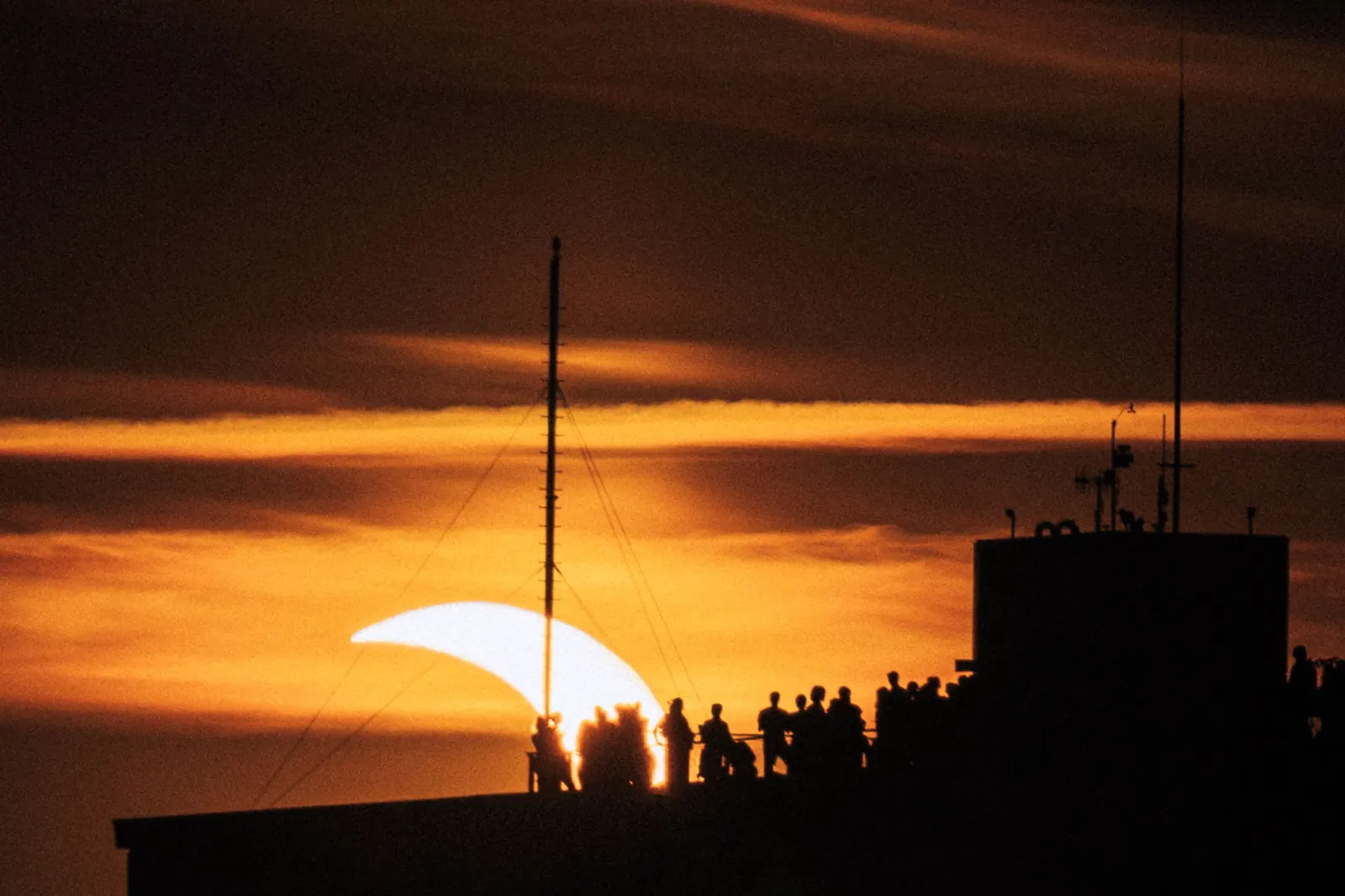
The shadow reached Spain in the evening, when the Sun was already low in the west. It entered over Galicia and Asturias, swept across Castile and Aragon and left the coast near Valencia before crossing the Balearic Islands. Madrid and Barcelona lay just outside the path and saw a deep partial eclipse instead.
Skies stayed clear. According to the Associated Press, millions of people gathered in cloudless towns and cities, with temperatures above 35°C (95°F) in many viewing areas. Authorities prepared about 350 official viewing sites, many of them in the thinly populated interior, where a low Sun over an open horizon matters more than anywhere else. In Medinaceli, in the province of Soria, Rosa Celiberti told the AP that “no matter how many photos or videos you’ve seen, nothing comes even close to what it actually feels like.”
| Where | Totality | Began | Sun height |
|---|---|---|---|
| A Coruña | 1m 20s | 20:27 | 12° |
| Oviedo | 1m 51s | 20:26 | 10° |
| León | 1m 48s | 20:28 | 10° |
| Burgos | 1m 47s | 20:28 | 8° |
| Soria | 1m 45s | 20:28 | 7° |
| Medinaceli | 1m 44s | 20:29 | 7° |
| Zaragoza | 1m 27s | 20:28 | 6° |
| Teruel | 1m 37s | 20:30 | 6° |
| Valencia | 1m 06s | 20:32 | 5° |
| Palma | 1m 39s | 20:30 | 3° |
Local time (CEST), from our own calculation.
Evening timing came at a price. In Valencia the Sun stood only 5 degrees above the horizon during totality, about half the height of a fist held at arm’s length, and in Palma just 3 degrees. A single building or a line of hills in the wrong place was enough to block the view.
The scramble for eclipse glasses
Eclipse glasses ran out across Spain in the last days before the eclipse. In Barcelona a pharmacist told Crónica Global that her shop bought 150 pairs and sold them all in less than a morning, and that it could have sold 500 more. Universe Magazine reported about 4 million pairs sold in Spain over the previous months, with demand still far higher.
Free glasses helped but did not close the gap. Spain’s Ministry of Science and the ONCE, the national organisation for blind people, handed out two million pairs under the campaign “Una vista única. Cuídala”, and the Catalan government planned 150,000 more at its viewing points on the day. Consumer authorities also ordered six models off the market for not protecting the eyes properly, a reminder that a box saying “eclipse glasses” is not proof of anything.
For 2027, buy certified glasses early, from a seller you trust, and check them against our eye safety checklist.
Roads, crowds and safety
Spain’s traffic authority, the DGT, had expected between 400,000 and 1.5 million extra car journeys towards the path. Afterwards, the government described the day as normal and without notable incidents. Its summary mentions traffic jams and temporary road closures at some coastal and busy viewing points, crowds larger than expected in places, a fire in an observation area at Liencres in Cantabria that was quickly put out, two fires on boats in the Balearic Islands and some isolated medical assistance.
All of it happened only weeks after a devastating wildfire in the province of Ávila, which burned about 500 square kilometres and forced tens of thousands of people to leave their homes, according to the AP.
Iceland: a lottery with the clouds
Iceland had the longest totality of the whole eclipse, up to 2 minutes 13 seconds on land at the cliffs of Látrabjarg, and the Sun was much higher than in Spain. The weather spoiled it. Heavy cloud and rain hid the Sun across much of the island, AFP reported, although the sudden darkness still reached everyone under the shadow.
It was Iceland’s first total eclipse since 1954, and the first seen from Reykjavík since 1433. Hotel rooms in the capital averaged $1,012 a night, roughly double the 2025 rate, and about 75,000 foreign tourists were in the country on the day, only slightly more than in a normal August. Steindór Jónsson, a Reykjavík hotelier, compared the rush with the 1986 summit in the city: “I started the hotel then, and we had Reagan and Gorbachev here. It was very hectic.”
What 2026 means for 2027
Spain gets a second chance in less than a year. On 2 August 2027 the shadow crosses the far south of Andalusia, with four to almost five minutes of totality along the Strait of Gibraltar instead of under two, and the Sun about 38 degrees high in the morning instead of a few degrees above the horizon at sunset.
The 2026 eclipse also showed what to expect. Glasses ran out, hotels near the path filled early and roads around popular sites jammed in the last hour. Anyone planning for 2027 can learn from that: buy glasses now, book refundable rooms, and pick a viewing spot you can reach without driving at the last moment. Our guides to Tarifa, Cádiz and Málaga have the local times, and My eclipse shows them for any spot.
Good questions
- When was the last total solar eclipse in Spain before 2026?
- On mainland Spain, on 30 August 1905. The Canary Islands saw a total eclipse on 2 October 1959.
- When is the next total solar eclipse in Spain?
- On 2 August 2027, less than a year later. Its path crosses the far south of Andalusia, the Strait of Gibraltar, Ceuta and Melilla, with totality of more than four minutes in places and the Sun high in the morning sky.
- Did anyone damage their eyes during the 2026 eclipse?
- The Spanish government’s summary reported only isolated medical assistance and no serious incidents. Eye injuries can take hours to appear and are not always reported, so the full picture may never be known.
Sources
- Associated Press via WDIV, Millions crowd Spanish cities to see country’s first total solar eclipse in over a century (12 August 2026)
- Crónica Global, Se agotan las gafas para ver el eclipse (11 August 2026)
- Universe Magazine, Solar eclipse caused a surge in demand for solar glasses in Spain
- Turismo de Estrellas, El Gobierno confirma un eclipse sin incidencias graves