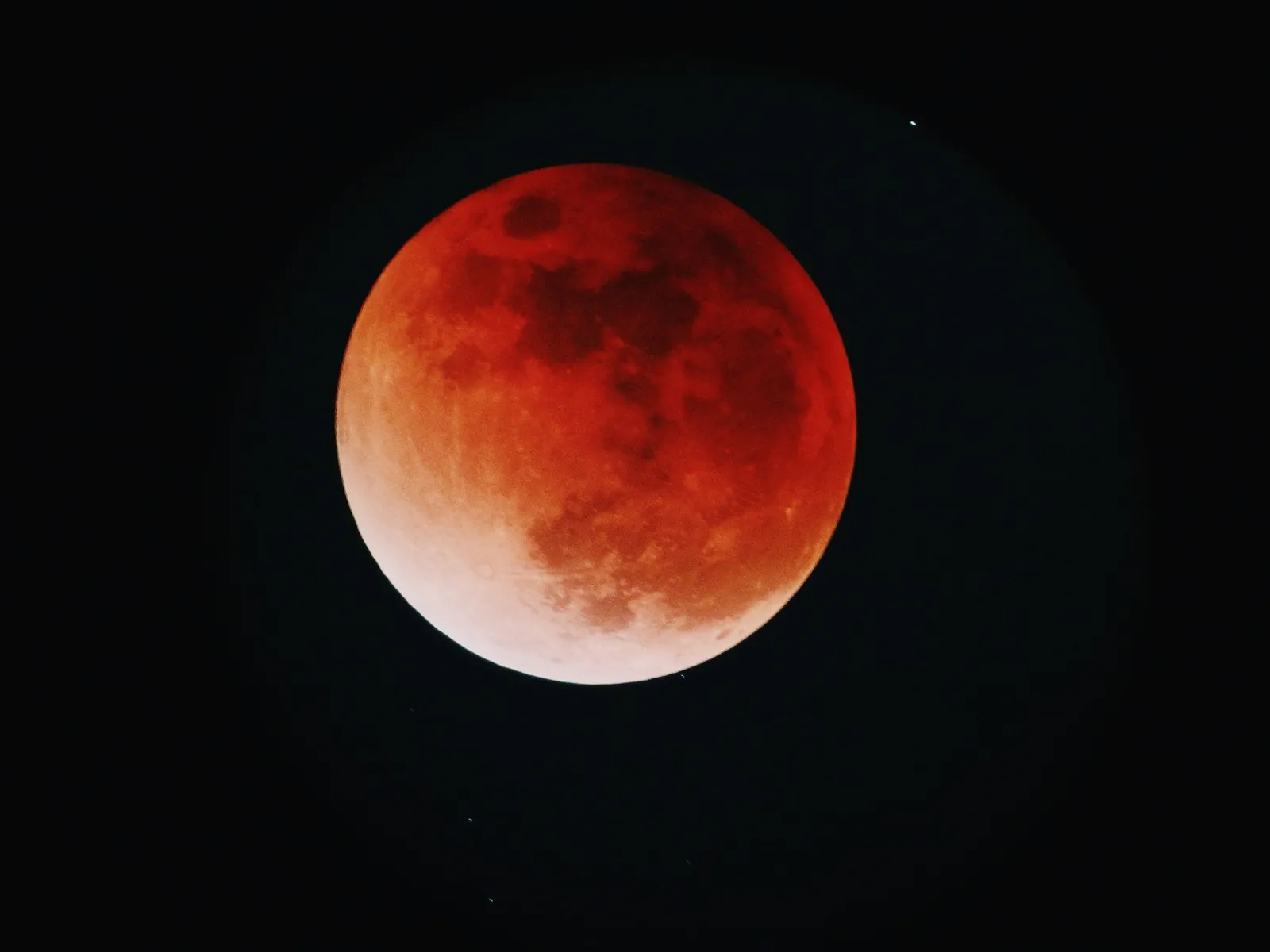
Light that bends around the Earth
Earth casts a long shadow into space, and during a total lunar eclipse the full Moon passes right through it. If Earth had no air, the Moon would go completely black. But our planet is wrapped in a thin layer of atmosphere, and that layer works like a ring-shaped lens. Sunlight that skims past the edge of the Earth is bent a little as it passes through the air, enough to fall into the shadow and light up the Moon.
Red, not white
On its way through the atmosphere, sunlight bumps into countless air molecules. They scatter blue light much more strongly than red, which is why the daytime sky is blue. The light that makes the long journey through the air at the edge of the Earth loses almost all its blue and green, so what is left is orange and red.
The same thing happens at every sunset: the Sun looks orange because its light crosses a thick layer of air near the horizon. During a lunar eclipse, the Moon is lit by all the sunrises and sunsets happening around the Earth at that moment, added together. If you could stand on the Moon during totality, you would see a black Earth surrounded by a thin, glowing red ring.
Why some eclipses are darker than others
From one eclipse to the next, the colour changes, from bright copper to a dark brown that is hard to see. Two things make the difference. The first is how deep the Moon goes into the shadow: the centre of the umbra receives less of the bent light than its edge, so an eclipse that passes through the middle is usually darker.
Earth’s atmosphere is the second factor. Clouds along the line between day and night block some light, and volcanic eruptions can block much more. According to NASA, the eruptions of Agung in 1963 and El Chichón in 1982 were followed by several years of very dark eclipses. After Pinatubo erupted in 1991, the total eclipse of 9 December 1992 was so dark that the Moon was hard to see with the naked eye.
Measuring the colour: the Danjon scale
The French astronomer André-Louis Danjon proposed a simple scale to describe how bright an eclipsed Moon looks at mid-totality. Amateur astronomers still use it today.
- L0Very dark. The Moon is almost invisible, especially at mid-totality.
- L1Dark, grey or brownish. Details on the Moon are hard to make out.
- L2Deep red or rust-coloured, with a very dark centre and a brighter outer edge.
- L3Brick red, often with a bright or yellowish rim.
- L4Very bright copper red or orange, with a bluish, very bright rim.
The blue band at the edge
Near the start and end of totality, sharp-eyed observers and cameras sometimes catch a thin turquoise band along the edge of the shadow. It comes from the ozone layer, high in the atmosphere. Ozone absorbs some of the orange and red light, so a little blue gets through in the light that passes through the upper atmosphere, and it lands near the edge of the umbra.
Where the name “blood moon” comes from
“Blood moon” is not an astronomical term. It is a popular name for a total lunar eclipse, after the deep red colour, and it has spread widely through news coverage in recent years. Astronomers simply say total lunar eclipse. Whatever you call it, the next chance to see one is on 31 December 2028, and the full list is in our lunar eclipse calendar.
Good questions
- Is a blood moon dangerous to look at?
- No. A lunar eclipse only dims the Moon, so it is completely safe to watch with the naked eye, binoculars or a telescope.
- Why is the Moon sometimes brown or almost black during an eclipse?
- Dust, cloud and volcanic haze in Earth’s atmosphere block part of the light that would otherwise reach the Moon. After large volcanic eruptions, eclipses can be so dark that the Moon is hard to find.
- When is the next red Moon?
- The next total lunar eclipse is on 31 December 2028.
Sources
- NASA eclipse website, Visual appearance of lunar eclipses
- EclipseWise, Danjon scale of lunar eclipse brightness
- timeanddate, Why does the Moon look red during a lunar eclipse?